

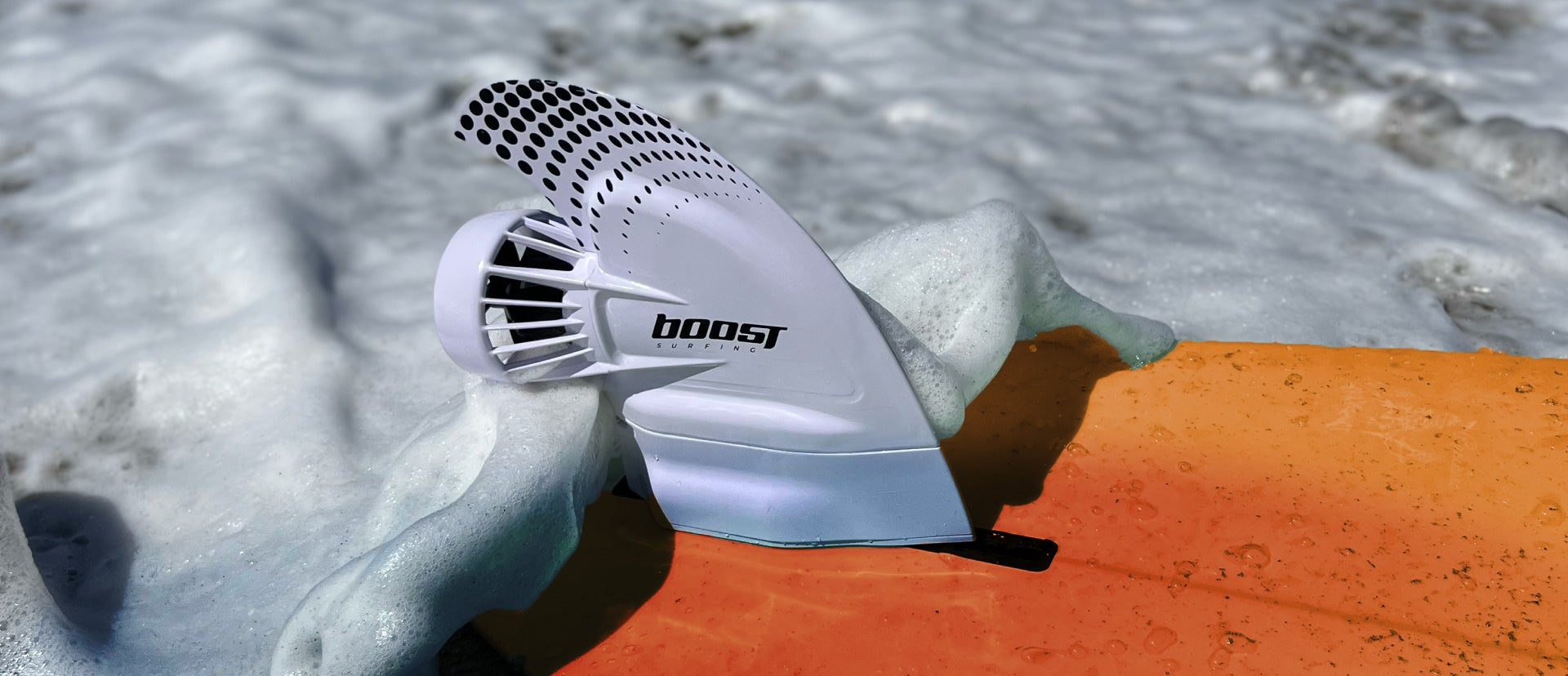
Electric fins still sound futuristic to many paddlers and surfers. And whenever a product challenges tradition, myths appear fast.
“Isn’t it cheating?”
“Does the battery die too quickly?”
“Is it safe?”
“Isn’t it only for beginners?”
If you’ve ever asked yourself these questions, you’re not alone.
This article breaks down the most common Boost Fin myths — honestly, clearly, and without hype — so you can decide whether it actually fits your way of being on the water.

Myth #1: “Boost Fin Does the Work for You”
Reality: Boost Fin doesn’t replace paddling — it supports it.
One of the biggest misconceptions is that an electric fin turns paddleboarding or surfing into a passive activity. In practice, Boost Fin works more like assisted momentum, not propulsion on its own.
Most riders:
- paddle normally
- use boost in short bursts
- combine paddling + boost for best results
You still balance. You still paddle. You still read water and waves.
Boost Fin simply helps you spend energy where it matters, instead of wasting it fighting wind or current.
Myth #2: “The Battery Life Is Too Short”
Reality: The runtime matches real SUP and surf sessions.
On paper, competitors may advertise longer runtimes. In real life, most paddleboard and surf sessions last 60–90 minutes.
Boost Fin is designed around that reality.
• Standard Boost Fin → ideal for typical sessions
• Long Range version → for extended paddles, family days, or touring
Instead of carrying heavy external batteries and cables, Boost Fin prioritizes:
- lighter weight
- compact design
- practical session length
For most users, the battery isn’t a limitation — it’s simply right-sized.

Myth #3: “It’s Only for Beginners”
Reality: Beginners use it — but experienced riders keep it.
Yes, beginners love Boost Fin because it reduces early frustration.
But many long-term users are:
- experienced paddlers
- surfers with decades in the water
- riders managing shoulder fatigue or recovery
Experienced riders tend to use Boost Fin more selectively:
- paddle-outs
- repositioning
- long upwind returns
- crowded lineups
It’s not about skill level — it’s about efficiency.
Myth #4: “Experienced Surfers Look Down on It”
Reality: Attitudes are changing fast.
A few years ago, electric assistance felt controversial. Today, it’s increasingly viewed as:
- an accessibility tool
- a session extender
- a smart way to stay active longer
Many surfers quietly use Boost Fin on half their sessions — especially on tougher days — and surf unassisted when conditions allow.
The focus is shifting from how you paddle to how much time you actually enjoy being in the water.

Myth #5: “It’s Unsafe”
Reality: Boost Fin is designed for controlled, responsible use.
Safety concerns usually come from imagining sudden acceleration or loss of control. In reality:
- thrust is gradual
- control is manual via wrist remote
- riders choose when to engage
Boost Fin doesn’t pull you unexpectedly. It responds only when you press the button.
Used responsibly — like any paddleboard accessory — it does not add meaningful risk.
Myth #6: “Installation Is Complicated”
Reality: If you can install a fin, you can install Boost Fin.
Boost Fin installs:
- without tools
- without drilling
- without wiring
It uses adapter systems compatible with most:
- inflatable SUPs
- hard boards
- kayaks
For many users, setup takes less than five minutes — often the easiest part of ownership.

Myth #7: “It’s Too Expensive for What It Does”
Reality: It’s one of the most affordable ways to motorize a board.
Compared to:
- full electric SUPs
- jet-style motors
- external battery systems
Boost Fin is:
- significantly cheaper
- portable
- usable across multiple boards
For many users, it replaces:
- gym-style paddle training
- short sessions cut by fatigue
- buying additional boards
Value isn’t just about price — it’s about how often you actually use it.
Myth #8: “It Ruins the Natural Feel”
Reality: Most riders forget it’s there — until they need it.
Boost Fin is quiet, subtle, and unobtrusive. When not engaged, it behaves like a normal fin.
Many riders report:
- forgetting it’s installed
- only using it when conditions change
- appreciating the option, not the constant power
It enhances sessions without dominating them.

So, Who Is Boost Fin Actually For?
Boost Fin tends to work best for:
- paddlers who value longer, calmer sessions
- surfers who want more waves with less fatigue
- families sharing boards
- riders balancing water time with busy lives
It’s not built for professional competition or towing into giant waves — and it doesn’t claim to be.
It’s built for real people, real sessions, and real conditions.
Final Thought: Myths Fade, Experience Doesn’t
Most Boost Fin myths come from assumptions — not usage.
Once people try it, the narrative usually shifts from:
“Is this too much?” to “Why didn’t I try this sooner?”
Not because it changes the sport — but because it changes how long, how often, and how comfortably you get to enjoy it.
And for most of us, that’s the part that matters.
Share:
Boost Fin for Beginners: Why It’s Easier (and More Fun) Than You Think
Most Instagrammable Paddleboarding Spots in the World